Research-backed science
The biology behind why your water matters more now.
The same hormonal shifts changing your hair and skin also make you more vulnerable to what is in your shower water. Here is the research — no marketing, no fluff.
The core insight
The compounding effect: 1 + 1 = 3.
Hormonal change and unfiltered water are not two separate problems. They compound each other, creating damage neither would cause alone.
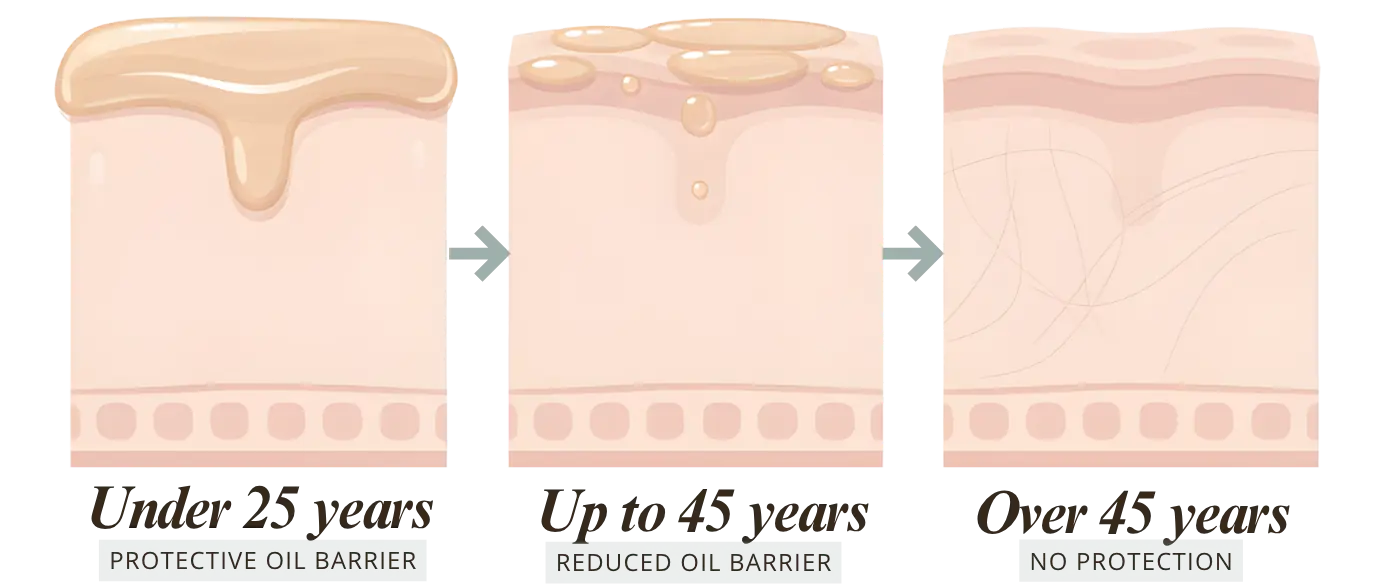
Less oil produced
Estrogen decline reduces sebum production. Your scalp and skin make fewer protective oils.
Remaining oil stripped
Chlorine oxidizes and strips what little natural oil your body still produces, leaving nothing behind.
Exponential dryness
No protective oil layer means products cannot absorb, follicles sit exposed, and every shower deepens the deficit.
The compounding factor. A woman at 50 with unfiltered water faces roughly double the effective moisture loss from each shower compared with her 25-year-old self — not because the water got worse, but because her body's ability to recover from it decreased.
Deep dive: how estrogen loss and chlorine create a vicious cycle+
Estrogen directly regulates sebum production through insulin-like growth factor receptors on sebocytes, the oil-producing cells. As estrogen declines through perimenopause and menopause, sebum output can drop significantly, leaving skin and scalp with less of their natural protective layer.
Chlorine is a powerful oxidant. Its entire purpose in municipal water is to kill living organisms by oxidizing their cell walls. On contact with skin and hair it does the same thing to your natural oils, breaking down the lipid barrier that keeps moisture in and irritants out.
At 25 this is not a major problem: young skin produces abundant sebum and rebuilds its oil layer quickly after a chlorinated shower. At 50 it is a different situation. Your body produces less oil and chlorine strips what remains, so there is not enough sebum to rebuild the barrier between showers. Each shower compounds the deficit — that is why dryness and irritation accelerate. It is not just aging. It is aging plus daily chemical exposure on a body that can no longer compensate.
Sources: Ashcroft et al., 1997 (estrogen / sebocyte regulation) · Brincat et al., 1987 (collagen / estrogen correlation) · dermatological skin-disorder research.
Hair biology
Your hair growth cycle is changing.
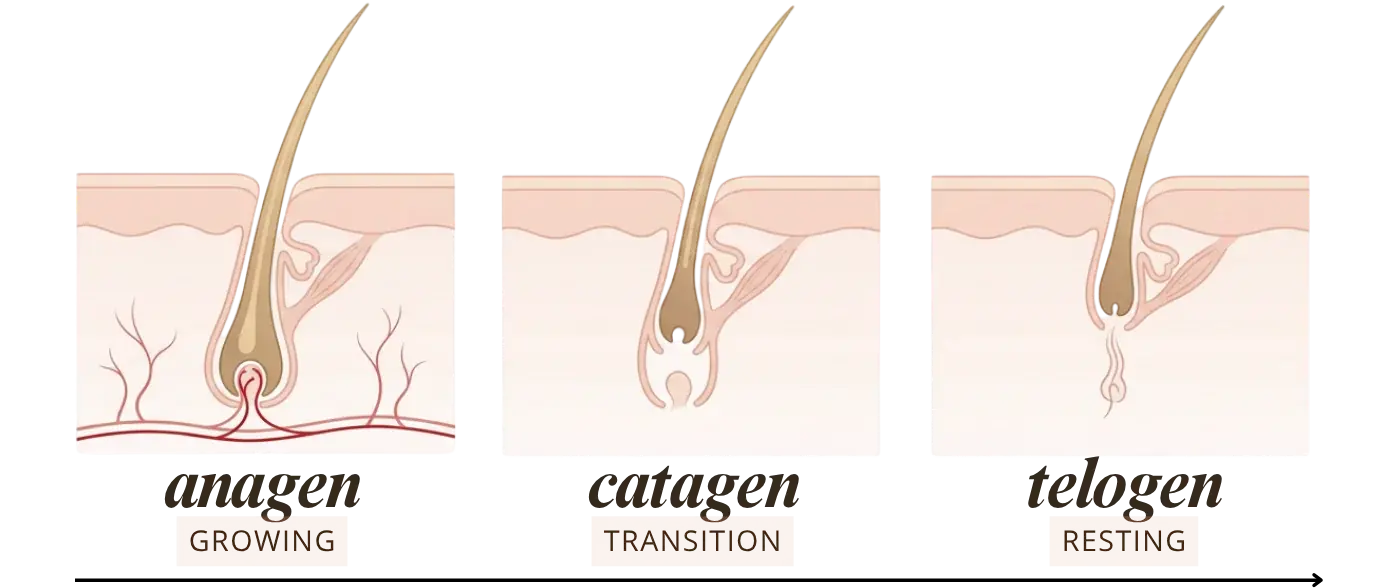
Every hair on your head runs a three-phase cycle. Menopause alters the timing. Unfiltered water stresses the cycle further.
Growth phase
Active growth. The follicle produces a hair shaft, matrix cells divide rapidly, melanocytes add pigment. This is when visible, healthy hair is built.
Transition phase
Growth stops. The follicle shrinks and detaches from its blood supply. The shaft keratinizes into a club hair — formed, but no longer growing.
Resting phase
The follicle is dormant. The club hair sits loosely until the next anagen phase pushes it out. This is normal daily shedding.
↓What menopause does to this cycle
- DHT sensitivity increases. As estrogen declines, androgens shrink follicles — the same mechanism behind male pattern baldness.
- Follicle miniaturization begins. Some follicles produce finer, shorter vellus hairs. Density drops before you see thin spots.
- Telogen lengthens. More follicles rest for longer, so fewer hairs are actively growing at any moment.
- Anagen shortens. Hair does not grow as long or as thick, especially across the frontal scalp.
↓What unfiltered water does on top of it
- Chloramines penetrate deeper. Used in more than 30% of U.S. systems, they reach the dermis where follicle roots live.
- Hard water clogs follicles. Mineral film blocks product absorption and physically occludes follicle openings.
- Heavy metals inflame. Lead, mercury and cadmium drive chronic inflammation, pushing hairs into telogen early.
- Chlorine strips sebum. Without it the follicle environment turns dry and inflamed, speeding the anagen-to-catagen shift.
What to expect once the water changes
Based on hair biology and customer feedback.
Less itching, less tightness, a softer feel. Chlorine removal works on surface oils immediately.
Reduced breakage, less shedding, better product absorption. Existing hairs get healthier and early new growth begins.
New growth is stronger and thicker. Cumulative follicle cycling shows visible density improvement. This is why the guarantee runs 90 days.
Deep dive: why the timeline is 8 to 12 weeks+
When people ask how long until they see results, the answer sits in hair biology. Each follicle cycles independently. Remove the environmental stressor and follicles already in anagen start growing healthier hair immediately — but you cannot see it until that hair grows out.
Scalp hair grows roughly one centimeter per month. A follicle entering anagen on install day will not produce visible hair for two to three weeks, and you need enough follicles to transition before the cumulative effect becomes noticeable.
Sources: Paus & Cotsarelis, 1999 (hair follicle biology) · StatPearls, hair physiology · ScienceDirect, menopause and hair loss, 2025.
Skin biology
Your skin barrier is thinning — and your water is making it worse.
Collagen collapse
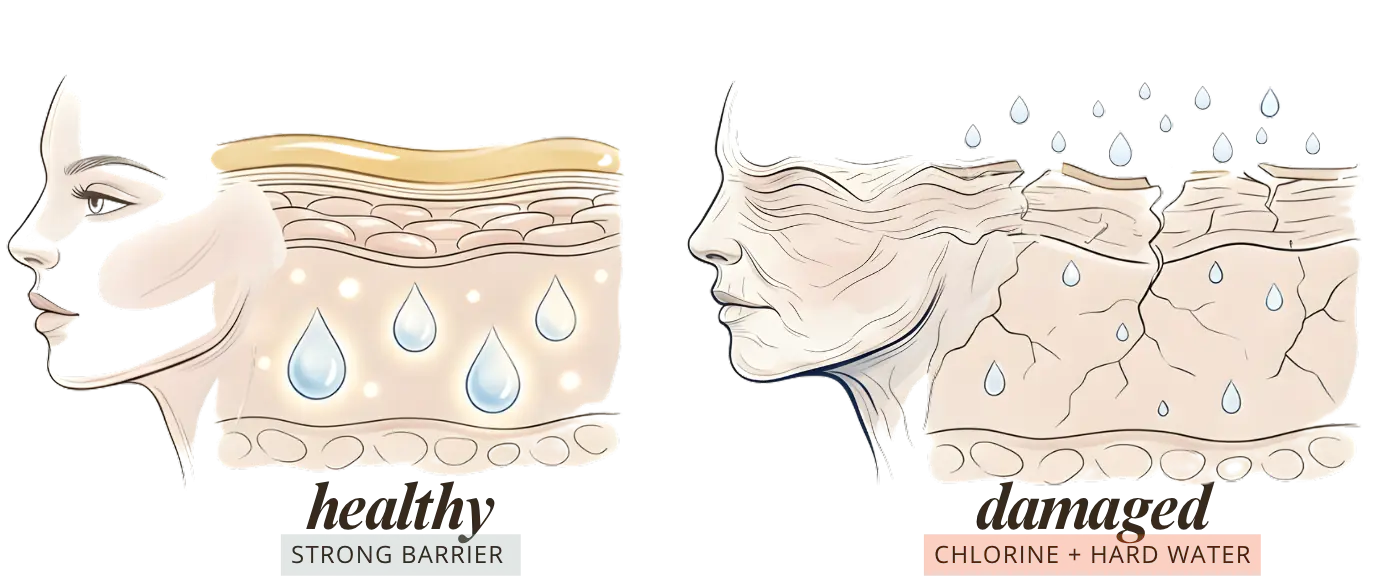
Estrogen stimulates Type I and Type III collagen, the proteins that give skin its firmness, and maintains elastin and hyaluronic acid. Clinical studies show collagen content declines with menopausal age rather than chronological age — up to 30% in five years, then about 2.1% every year after.
Acid mantle disruption
Your skin holds a slightly acidic surface at pH 4.5–5.5. Hard water is alkaline at pH 7–8.5, so every shower pushes that number up, and concentrated chlorine pushes it further. For skin already producing less sebum, the recovery takes days instead of hours.
Deep dive: why dermatologists recommend shower filters for skin conditions+
Eczema, psoriasis and chronic dryness are all conditions where the barrier is already compromised. The stratum corneum acts like a fine mesh, keeping moisture in and irritants out. In these conditions, that mesh has gaps.
Showering in chlorinated hard water pushes two aggressive agents through an already weakened barrier: chlorine, which kills beneficial surface bacteria and strips oils, and calcium and magnesium minerals, which deposit on skin and raise its pH. For healthy skin this is manageable. For thinner, drier skin with eczema or psoriasis it triggers a cascade of moisture loss, inflammation and flare-ups.
Most municipal systems hold chlorine above 1.5 ppm, higher than the recommended maximum for swimming pools. You are showering in water more chlorinated than a pool, with skin that has less protection than it had a decade ago.
Sources: Brincat et al., 1987 (collagen / menopausal age) · Duarte et al., 2016 (stratum corneum / estrogen) · PMC, estrogens and aging skin.
The timing factor
Why filtered water matters more at 45+.
The same contaminants were in your water at 25. Here is why they did not matter as much then.
| At 25 | At 50+ | |
|---|---|---|
| Sebum production | Abundant, recovers quickly | Declining, slow recovery |
| Collagen content | Peak levels | 30%+ lost post-menopause |
| Skin thickness | Full thickness | Decreasing ~1.1% a year |
| Follicle density | Maximum density | Miniaturizing, fewer anagen hairs |
| Acid mantle recovery | Hours after disruption | Days after disruption |
| Antioxidant defense | Estrogen provides protection | Estrogen protection declining |
| Product absorption | Good, minimal buildup | Blocked by mineral deposits |
| Damage from chlorine | Temporary, rebounds next day | Cumulative, compounds daily |
Deep dive: oxidative stress rises even though the water never changed+
Estrogen is one of the body's primary antioxidant defenses, protecting skin cells against oxidative damage by modulating free radical production. As estrogen falls through menopause, skin becomes significantly more susceptible to oxidative damage from environmental sources.
Chlorine is an oxidant — it works by oxidizing organic matter. When your internal antioxidant defense declines while external oxidant exposure stays constant, net oxidative stress on skin and hair increases. That is why many women say their hair and skin suddenly got worse in their mid-forties even though nothing else changed. The water did not get worse. The ability to defend against it did.
Sources: Bottai et al., 2013 (estrogen / oxidative damage) · PMC, estrogen-deficient skin · ScienceDirect, topical therapy for EDS.
The solution
What filtered water actually does.
We are not claiming to reverse menopause. Here is what a shower filter can and cannot do, honestly.
✓What Chelate-X can do
- Stop chlorine from stripping the natural oils you still produce, every shower
- Neutralize hard-water minerals so they slide past your skin instead of coating it
- Reduce heavy metals linked to chronic scalp inflammation
- Clear the mineral film that blocks product absorption
- Bring water pH closer to your skin's acid mantle
- Remove common eczema, psoriasis and dermatitis flare triggers
- Let the products you already own actually penetrate and work
- Create a less hostile environment for follicles under hormonal stress
✕What Chelate-X cannot do
- Reverse hormonal hair loss or restore estrogen levels
- Regrow hair from follicles that have permanently miniaturized
- Replace medical treatments like minoxidil or HRT
- Cure eczema, psoriasis or dermatitis
- Change a genetic predisposition to thinning
- Compensate for nutritional deficiencies — iron, zinc, B12, vitamin D
- Replace a dermatologist's evaluation for significant hair loss
- Work overnight; real results take 4 to 12 weeks
Think of it this way. A filtered showerhead does not fix the hormonal problem. It removes the environmental problem that is making the hormonal problem worse.
Clinical perspective
What dermatologists say.
Peer-reviewed research and clinical perspectives on water quality, hormonal change and skin health.
"Dermatologists often recommend shower filters for patients with sensitive skin or chronic conditions like eczema and acne. Removing chlorine and metals helps prevent dryness and irritation while maintaining skin hydration and elasticity."
Dr. Dendy Engelman · AAD research"The perimenopausal years are marked by an accelerated decline in skin quality, largely due to declining estrogen levels. Collagen content declines at 2.1% per postmenopausal year, correlating with estrogen deficiency rather than chronological age."
Brincat et al. · European Medical Journal"Hard water leaves behind mineral residue that can clog pores and dry out skin by disrupting its natural barrier. For people with eczema or psoriasis the barrier is already thinner and more delicate, making filtered water a particularly meaningful intervention."
Dermatology research review"Chlorine is a strong oxidant that causes damage to skin and hair even at very low levels. Most tap water maintains chlorine levels greater than recommended for swimming pools. It kills beneficial bacteria on the skin surface that provide natural defense against skin disorders."
Aquasana dermatological researchNow you know the science
You cannot control your hormones. You can control what touches you daily.
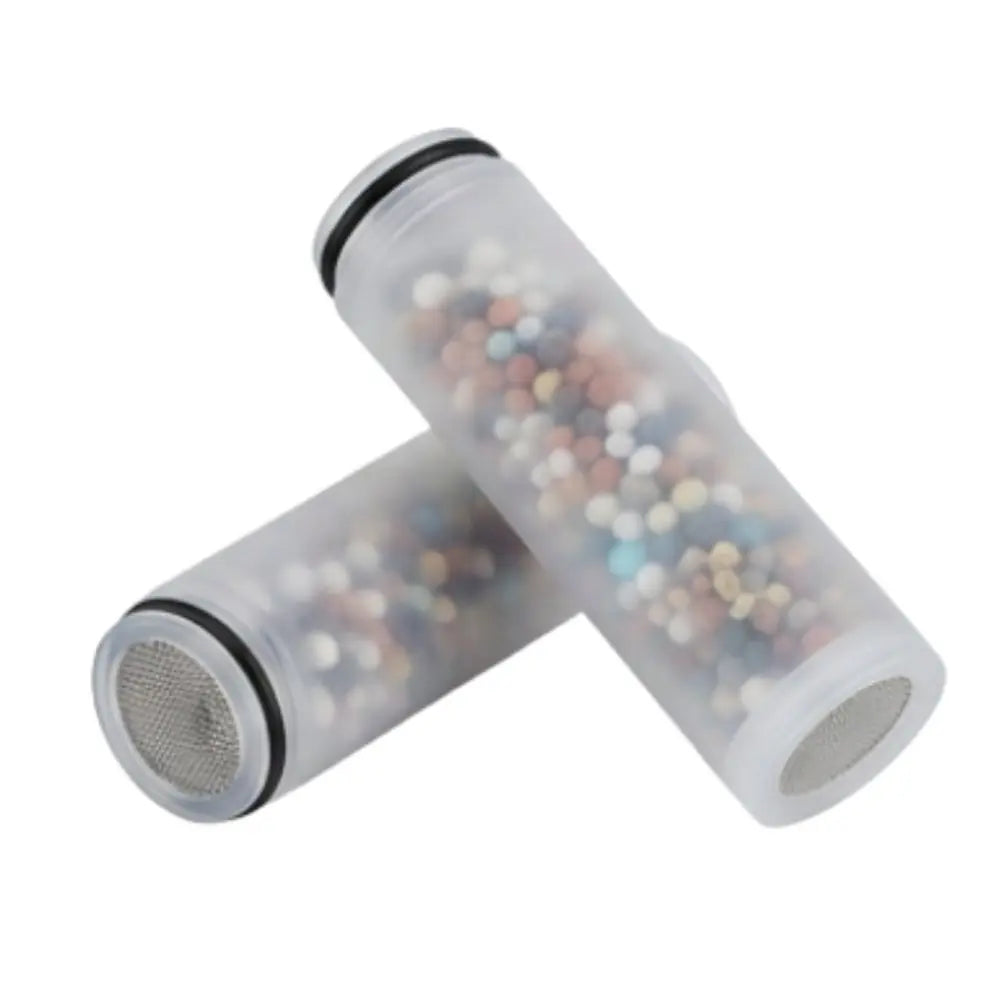
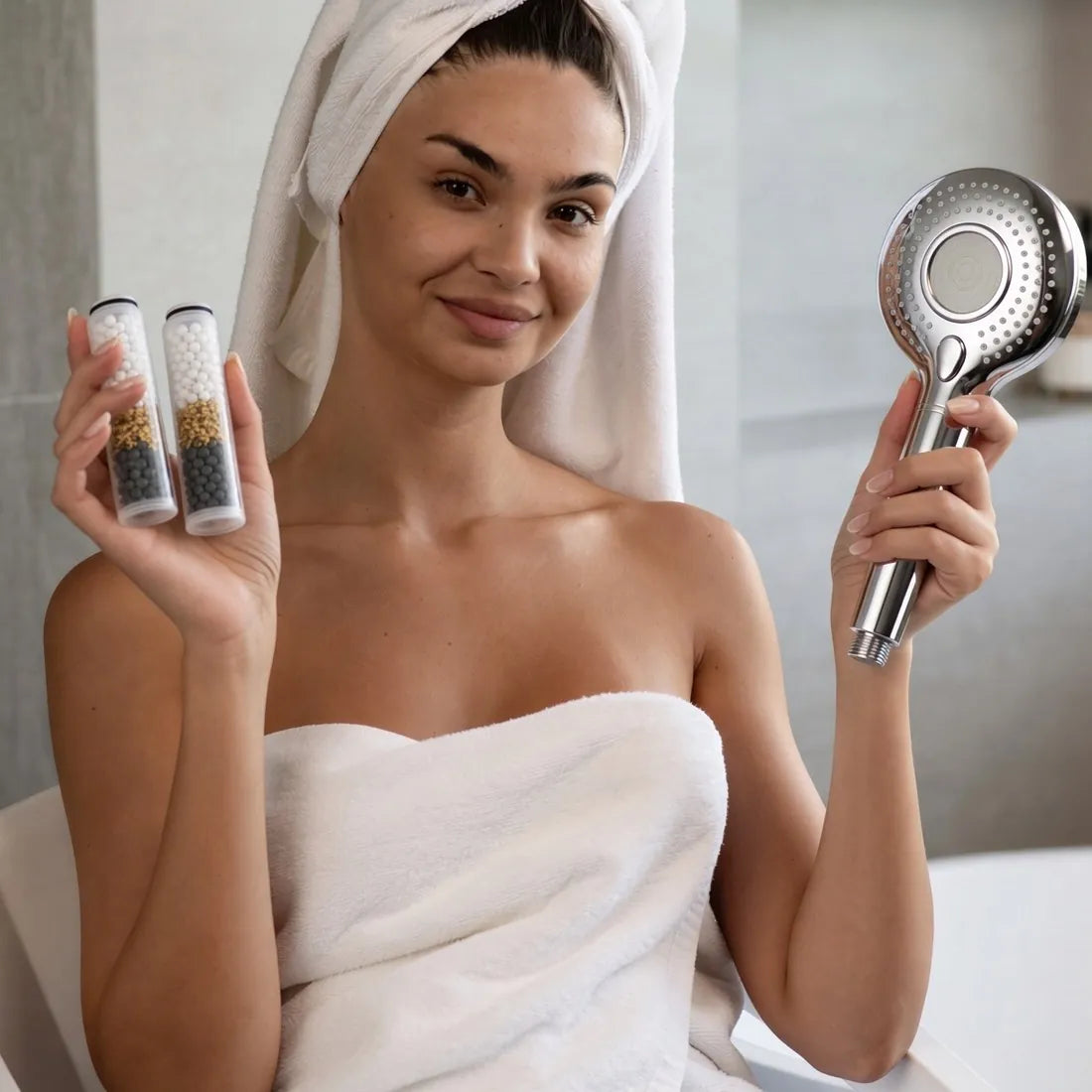
Chelate-X neutralizes hard water right at the head. Chlorine, metals and the minerals that dull your hair never make it past the cartridge. It installs in five minutes, ships free and carries a 90-day money-back guarantee.
Shop the Chelate-X Kit →